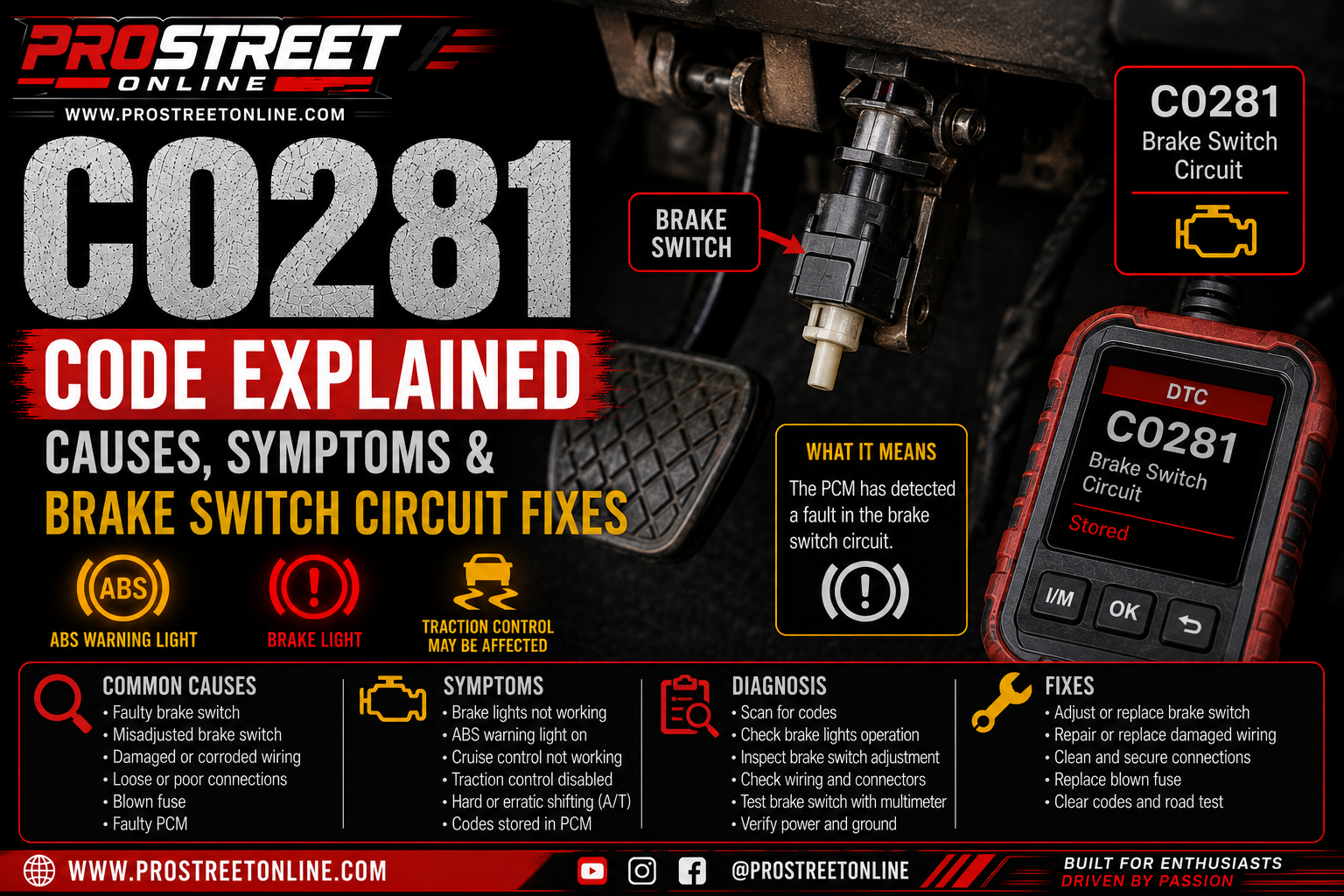
If you’ve scanned your vehicle and discovered a C-code, you’re dealing with a Chassis Diagnostic Trouble Code (DTC). Unlike powertrain (P), body (B), or network (U) codes, C codes focus on the systems that keep your vehicle driving, braking, steering, and handling safely.
These systems include:
- Anti-lock Braking Systems (ABS)
- Electronic Stability Control (ESC/StabiliTrak)
- Traction Control Systems (TCS)
- Electronic Power Steering (EPS)
- Four-Wheel Drive (4WD) systems
- Electronic Suspension
- Air Suspension
- Electronic Parking Brakes
- Wheel Speed Sensors
- Transfer Case Controls
- Differential Lock Systems
- Chassis Control Modules
Whether you’re troubleshooting an illuminated ABS light, a Service 4WD warning, a traction control problem, or an electronic suspension fault, our growing library of C Code OBD-II guides provides detailed explanations, symptoms, causes, diagnosis procedures, repair costs, and preventative maintenance advice.
What Are C Codes?
OBD-II Diagnostic Trouble Codes are divided into four major categories:
- P Codes – Powertrain
- B Codes – Body
- C Codes – Chassis
- U Codes – Network Communication
A C Code is stored whenever a chassis-related control module detects an electrical, mechanical, or communication problem within a monitored system.
Unlike engine codes, chassis codes are often stored by modules such as:
- Electronic Brake Control Module (EBCM)
- Electronic Power Steering Module (EPS)
- Transfer Case Control Module (TCCM)
- Suspension Control Module
- Electronic Parking Brake Module
- Four-Wheel Drive Module
- Chassis Control Module
Because many of these modules communicate over the CAN bus, multiple warning lights may illuminate simultaneously when a single fault occurs.
Common Symptoms of Chassis Codes
Depending on the system involved, a C-code may cause:
- ABS warning light
- Brake warning light
- Traction Control light
- Stability Control warning
- Service 4WD message
- Steering assist problems
- Suspension warning light
- Electronic parking brake warning
- Reduced braking performance
- Loss of traction control
- Four-wheel drive engagement issues
- Adaptive suspension faults
Some C-codes only illuminate a warning light, while others disable important safety features until repairs are completed.
Are C Codes Serious?
Many chassis codes affect critical safety systems.
Although most vehicles remain drivable, a stored chassis code may disable:
- Anti-lock brakes (ABS)
- Electronic Stability Control
- Traction Control
- Four-wheel drive operation
- Adaptive suspension
- Electronic steering assist
- Electronic parking brake functions
Ignoring these problems can reduce vehicle safety, particularly during emergency braking or poor weather conditions.
What Causes Chassis Codes?
The most common causes include:
- Failed wheel speed sensors
- Damaged wiring harnesses
- Corroded electrical connectors
- Weak batteries
- Charging system faults
- Faulty ABS modules
- Transfer case actuator failures
- Steering angle sensor failures
- Electronic suspension component failures
- Poor ground connections
- Failed actuators
- Water intrusion
- Worn electric motors
- Internal module failures
Proper diagnosis should always begin with a professional scan tool capable of reading manufacturer-specific chassis modules, not just generic engine codes.
C Code Diagnostic Guides
Below you’ll find our complete library of C Code explanations. New guides are added regularly as we continue expanding the database.
C0035–C0050 Wheel Speed Sensor Codes
These codes cover the wheel speed sensors used by the ABS and traction control systems.
- C0035 Code Explained – Left Front Wheel Speed Sensor Circuit
- C0040 Code Explained – Right Front Wheel Speed Sensor Circuit
- C0045 Code Explained – Left Rear Wheel Speed Sensor Circuit
- C0050 Code Explained – Right Rear Wheel Speed Sensor Circuit
C0110–C0298 ABS & Electronic Brake Control Codes
These codes involve the ABS hydraulic unit, Electronic Brake Control Module (EBCM), pressure circuits, torque reduction requests, and related braking electronics.
Included guides:
- C0110
- C0131
- C0245
- C0246
- C0248
- C0252
- C0265
- C0267
- C0268
- C0269
- C0271
- C0272
- C0273
- C0274
- C0275
- C0276
- C0277
- C0278
- C0281
- C0283
- C0284
- C0290
- C0291
- C0292
- C0298
C0300–C0387 Transfer Case & Four-Wheel Drive Codes
These guides cover transfer case electronics, encoder motors, front axle actuators, range switches, and shift system diagnostics.
Current articles include:
- C0300
- C0305
- C0306
- C0308
- C0309
- C0310
- C0315
- C0321
- C0323
- C0324
- C0327
- C0329
- C0357
- C0362
- C0367
- C0374
- C0376
- C0387
C0550–C0611 Electronic Control Module Codes
These articles focus on controller faults, module communication, VIN programming, and system disable conditions.
Available guides:
C0896–C0912 Voltage & Current Circuit Codes
Modern vehicles monitor actuator voltage and current continuously. These codes diagnose low voltage, high voltage, current performance, current circuit failures, and electrical performance issues.
Current guides include:
More voltage and actuator diagnostic guides are currently in development.
How We Diagnose C Codes
Every guide on Pro Street follows a professional diagnostic process that includes:
- Reading all stored chassis module codes
- Inspecting freeze-frame and live data
- Verifying battery and charging system health
- Performing voltage-drop testing
- Testing wiring continuity
- Inspecting connectors and grounds
- Measuring actuator current draw when applicable
- Verifying repairs with multiple drive cycles
This approach helps prevent unnecessary parts replacement and reduces repair costs.
Frequently Asked Questions
What is a C code?
A C code is an OBD-II Chassis Diagnostic Trouble Code used to identify problems with braking, steering, suspension, four-wheel drive, wheel speed sensors, and other electronically controlled chassis systems.
Can I drive with a C code?
Many C codes will not prevent the vehicle from driving, but important safety systems such as ABS, traction control, or stability control may be disabled. Diagnosis should be performed as soon as possible.
Do C codes turn on the Check Engine Light?
Usually not.
Most chassis faults illuminate the ABS, Brake, Stability Control, or Traction Control warning lights instead of the Check Engine Light.
Can a weak battery cause C codes?
Yes.
Many chassis control modules are sensitive to battery voltage. A weak battery or failing alternator can trigger multiple chassis DTCs simultaneously.
Do I need a professional scan tool?
For most C codes, yes.
Basic OBD-II scanners often cannot communicate with ABS, suspension, transfer case, or steering modules. A scan tool capable of reading manufacturer-specific chassis modules is recommended.
Why Trust Pro Street?
Every diagnostic guide on Pro Street is written specifically for automotive enthusiasts, DIY mechanics, and professional technicians. Rather than simply listing a definition, our articles explain:
- What the code actually means
- Why it occurs
- Common symptoms
- Root causes
- Professional diagnostic procedures
- Estimated repair costs
- Frequently asked questions
- Preventative maintenance tips
Our goal is to help you diagnose the problem correctly the first time.
More OBD-II Resources
Looking for other diagnostic trouble codes?
Browse our complete code libraries:
- Powertrain (P) Codes
- Body (B) Codes Explained –
- Chassis (C) Codes
- Network (U) Codes
Or visit the complete OBD-II DTC hub: