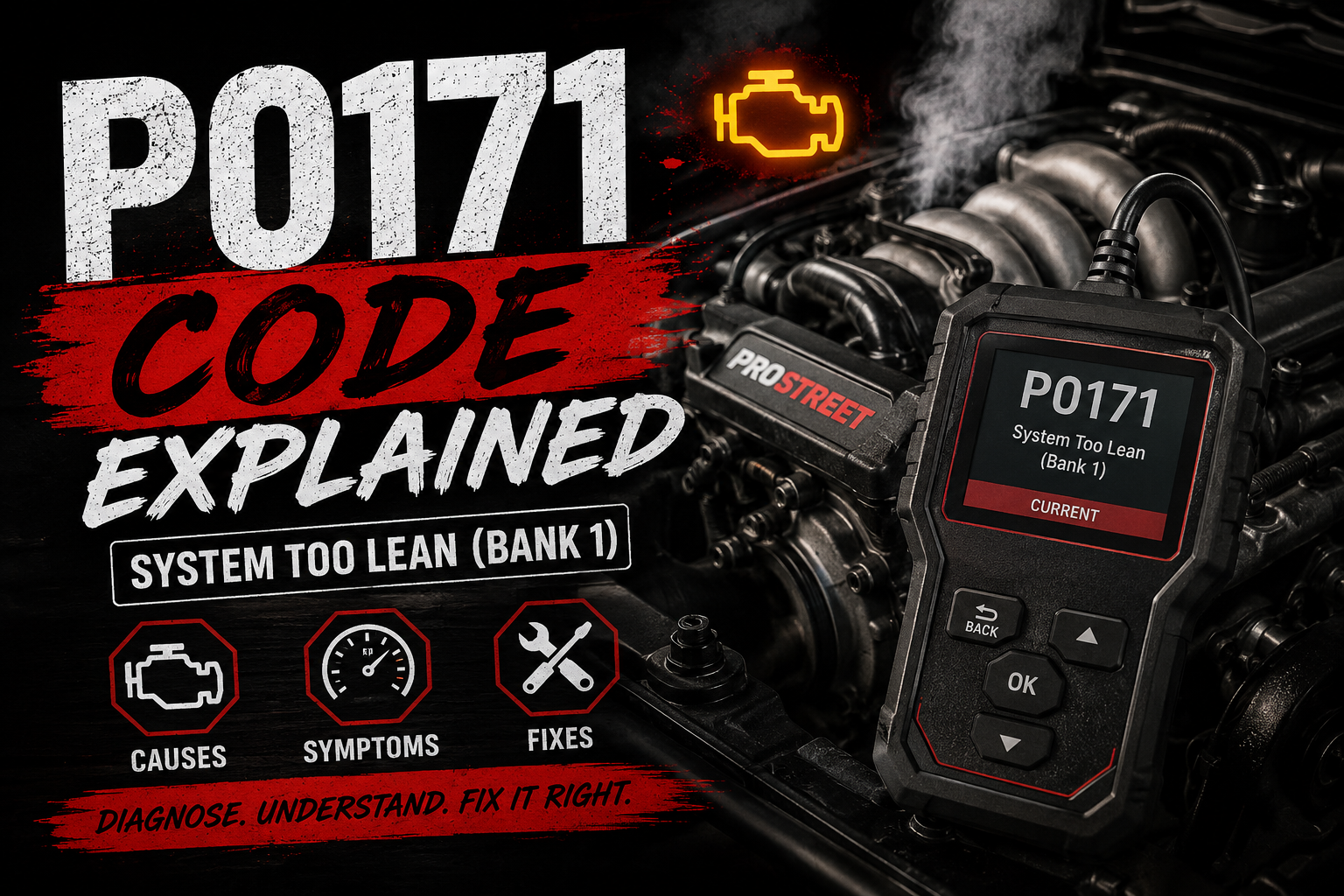
What Does the P0301 Code Mean?
If your check engine light is on and your OBD-II scanner displays P0301, your vehicle’s Engine Control Module (ECM) has detected a misfire in Cylinder 1.
Unlike the general P0300 code, which indicates random or multiple cylinder misfires, P0301 pinpoints the problem to Cylinder #1, allowing for a much more targeted diagnosis.
A misfire occurs when the air/fuel mixture inside the cylinder fails to ignite properly—or doesn’t ignite at all. Modern engine computers monitor crankshaft speed after every combustion event. When Cylinder 1 doesn’t produce the expected amount of power, the ECM stores Diagnostic Trouble Code (DTC) P0301 and turns on the Check Engine Light.
P0301 is one of the most common OBD-II trouble codes found on vehicles from Honda, Toyota, Ford, Chevrolet, Nissan, Subaru, BMW, Volkswagen, Hyundai, Kia, Jeep, Dodge, GMC, and many others.
Quick Answer
| Item | Information |
|---|---|
| Code | P0301 |
| Description | Cylinder 1 Misfire Detected |
| Severity | ⭐⭐⭐⭐☆ High |
| Safe to Drive? | Only if the misfire is minor |
| Common Causes | Spark plug, ignition coil, fuel injector, compression loss |
| Estimated Repair Cost | $30–$4,000+ |
What Is Cylinder 1?
Every engine has a designated Cylinder #1, which serves as the reference point for engine timing.
Its location varies depending on the manufacturer:
- Inline-4 engines: Usually closest to the timing belt or timing chain.
- V6 and V8 engines: Typically located on Bank 1, although the exact position depends on the manufacturer.
Always consult a factory service manual or firing order diagram before replacing ignition components.
What Is an Engine Misfire?
An engine needs five things for proper combustion:
- Air
- Fuel
- Spark
- Compression
- Correct valve timing
If Cylinder 1 loses any one of these, combustion becomes weak or stops completely, causing a misfire.
Symptoms of a P0301 Code
Common symptoms include:
- Check Engine Light
- Flashing Check Engine Light
- Rough idle
- Engine shaking
- Loss of power
- Poor acceleration
- Hard starting
- Increased fuel consumption
- Fuel smell from exhaust
- Engine hesitation
- Stalling (severe cases)
The severity depends on how often Cylinder 1 is misfiring.
How Serious Is P0301?
Severity: ⭐⭐⭐⭐☆ (High)
A single-cylinder misfire might seem minor, but continued driving can cause:
- Catalytic converter damage
- Burned exhaust valves
- Damaged piston
- Poor fuel economy
- Engine overheating
- Internal engine damage
A flashing Check Engine Light means the catalytic converter is actively being damaged.
Can You Drive With P0301?
Sometimes
If:
- Engine still runs relatively smoothly
- No flashing Check Engine Light
- Only occasional hesitation
You may drive a short distance to a repair facility.
Stop Driving Immediately If
- Check Engine Light flashes
- Engine shakes violently
- Severe power loss develops
- Vehicle stalls
- Strong fuel smell appears
Driving with an active misfire can destroy an expensive catalytic converter.
Most Common Causes of P0301
| Cause | Likelihood |
|---|---|
| Worn spark plug | ⭐⭐⭐⭐⭐ |
| Bad ignition coil | ⭐⭐⭐⭐⭐ |
| Faulty fuel injector | ⭐⭐⭐⭐ |
| Vacuum leak near Cylinder 1 | ⭐⭐⭐ |
| Low compression | ⭐⭐⭐ |
| Intake manifold leak | ⭐⭐⭐ |
| Burned exhaust valve | ⭐⭐ |
| Damaged piston ring | ⭐⭐ |
| Timing issue | ⭐⭐ |
| Wiring problem | ⭐⭐ |
Most Common Repairs
| Repair | Likelihood | Average Cost |
|---|---|---|
| Replace Spark Plug | Very High | $30–250 |
| Replace Ignition Coil | Very High | $80–400 |
| Replace Fuel Injector | High | $200–700 |
| Repair Vacuum Leak | Medium | $50–300 |
| Compression Repair | Medium | $1,500–5,000 |
| Valve Repair | Medium | $1,500–4,000 |
Tools You’ll Need
- OBD-II Scanner
- Live Data Scan Tool
- Spark Tester
- Digital Multimeter
- Compression Tester
- Fuel Pressure Gauge
- Noid Light
- Smoke Machine
Step-by-Step Diagnosis
Step 1: Confirm Cylinder 1 Misfire
Verify:
- P0301 is current
- No additional cylinder misfire codes
- Freeze-frame data
Record RPM, engine load, coolant temperature, and fuel trims before clearing the code.
Step 2: Inspect the Spark Plug
Remove the Cylinder 1 spark plug.
Check for:
- Oil fouling
- Carbon buildup
- Cracked porcelain
- Excessive wear
- Incorrect gap
Replace if worn or damaged.
Step 3: Swap the Ignition Coil
If your engine uses coil-on-plug ignition:
Swap Cylinder 1’s coil with another cylinder.
If the code changes from:
P0301 → P0302
the ignition coil is faulty.
Step 4: Check the Fuel Injector
Listen for injector clicking.
If necessary:
- Measure injector resistance.
- Perform an injector balance test.
- Swap injectors (where practical).
Step 5: Perform Compression Test
Low compression may indicate:
- Burned valve
- Broken piston ring
- Head gasket failure
- Damaged piston
Cylinder compression should generally be within 10–15% of the other cylinders.
Step 6: Inspect for Vacuum Leaks
Leaks near Cylinder 1 can lean out only that cylinder.
Inspect:
- Intake gasket
- Vacuum hoses
- PCV system
- Intake manifold
Step 7: Check Fuel Trim and Live Data
Review:
- STFT
- LTFT
- Misfire counters
- O2 sensor activity
Live data often reveals the true cause faster than replacing parts.
Common Diagnostic Mistakes
Avoid these expensive mistakes:
- Replacing all ignition coils
- Ignoring compression testing
- Replacing injectors without testing
- Clearing codes too early
- Ignoring vacuum leaks
- Replacing the catalytic converter first
Always diagnose before replacing components.
Vehicle-Specific P0301 Problems
Ford
Common causes:
- Coil-on-plug failure
- Spark plug wear
- PCV leaks
Popular models:
- F-150
- Mustang
- Explorer
- Escape
Chevrolet / GMC
Frequently caused by:
- AFM lifter failure
- Coil packs
- Fuel injectors
Honda
Often related to:
- Valve clearance adjustment
- Ignition coils
- Spark plugs
Common models:
- Civic
- Accord
- CR-V
Toyota
Common causes:
- Ignition coils
- Spark plugs
- Fuel injectors
Subaru
Frequently caused by:
- Low compression
- Head gasket failure
- Ignition coil issues
BMW
Often traced to:
- Ignition coils
- VANOS timing
- Carbon buildup
- Fuel injectors
Volkswagen / Audi
Common failures include:
- Ignition coils
- Carbon buildup
- PCV failures
Dodge / Jeep / Ram
Often associated with:
- HEMI lifters
- Camshaft wear
- Ignition coils
Repair Costs
| Repair | Average Cost |
|---|---|
| Spark Plug | $30–250 |
| Ignition Coil | $80–400 |
| Fuel Injector | $200–700 |
| Vacuum Leak | $50–300 |
| Valve Repair | $1,500–4,000 |
| Engine Repair | $2,500–6,000+ |
Related Trouble Codes
P0301 commonly appears with:
- P0300 – Random/Multiple Cylinder Misfire
- P0302 – Cylinder 2 Misfire
- P0303 – Cylinder 3 Misfire
- P0304 – Cylinder 4 Misfire
- P0171 – System Too Lean
- P0172 – System Too Rich
- P0420 – Catalyst Efficiency Below Threshold
- P0430 – Catalyst Efficiency Below Threshold
- P0016 – Crankshaft/Camshaft Correlation
Frequently Asked Questions
Can I drive with a P0301 code?
You may be able to drive a short distance if the engine runs smoothly, but prolonged driving with a misfire can damage the catalytic converter and engine.
Can a bad spark plug cause P0301?
Yes. A worn, fouled, or incorrectly gapped spark plug is one of the most common causes of a Cylinder 1 misfire.
Will replacing the ignition coil fix P0301?
If testing confirms the ignition coil has failed, replacing it will resolve the issue. Always verify by swapping coils or using scan tool data before replacing parts.
Can low compression trigger P0301?
Absolutely. Burned valves, damaged piston rings, or head gasket failures can all reduce compression and cause Cylinder 1 to misfire.
Why is my Check Engine Light flashing?
A flashing Check Engine Light indicates an active misfire severe enough to potentially damage the catalytic converter. Reduce speed immediately and repair the issue as soon as possible.
Final Thoughts
The P0301 Cylinder 1 Misfire Detected code is one of the easiest misfire codes to diagnose because it identifies the exact cylinder experiencing combustion problems. In many cases, the culprit is something relatively simple, such as a worn spark plug or failing ignition coil. However, fuel injector issues, vacuum leaks, low compression, or valve train problems can also be responsible.
Start with the basics, test each component methodically, and avoid replacing parts based on guesswork. A proper diagnosis not only saves money but also prevents costly catalytic converter damage and restores your engine’s performance.