


A bigger turbo can turn a mild street car into a serious pull machine. It can also create lag, heat, fuel pressure problems, and an expensive pile of parts that do not work together. This turbocharger upgrade guide cuts through the hype so you can choose the right hardware, support it properly, and spend your budget where it actually makes power.
Start With a Real Power Goal
“Biggest turbo possible” is not a build plan. Start with the horsepower and torque range you want, where you want it in the RPM band, and how you will use the vehicle. A daily-driven truck that tows needs a very different turbo setup than a high-RPM weekend car built for roll racing.
Be honest about the target. If your stock engine, transmission, clutch, fuel system, or cooling system is comfortable at 350 horsepower, chasing 600 horsepower with a turbo alone is a fast way to break parts. Set a realistic wheel-horsepower goal, then leave room for future growth without buying a turbo that feels dead until 4,500 RPM.
Street builds usually reward fast spool and broad midrange torque. Track builds may accept more lag in exchange for higher airflow at the top end. Diesel owners should also consider exhaust gas temperature, towing load, and transmission capacity before adding boost.

Turbocharger Upgrade Guide: Choose the Right Size
Turbo sizing is about airflow, not just the size of the compressor wheel or the number stamped on the housing. A properly sized turbo moves enough air for your power goal while spooling in a usable RPM range. Too small, and it can become a hot restriction at high boost. Too large, and the car may feel soft everywhere you drive most often.
The engine’s displacement matters. So do the cylinder head flow, compression ratio, camshaft, exhaust manifold, intended boost pressure, and fuel type. A 2.0L four-cylinder and a 5.3L V8 can make similar peak power with different turbo choices because they move air differently and operate in different RPM ranges.
Compressor Side: Power Potential
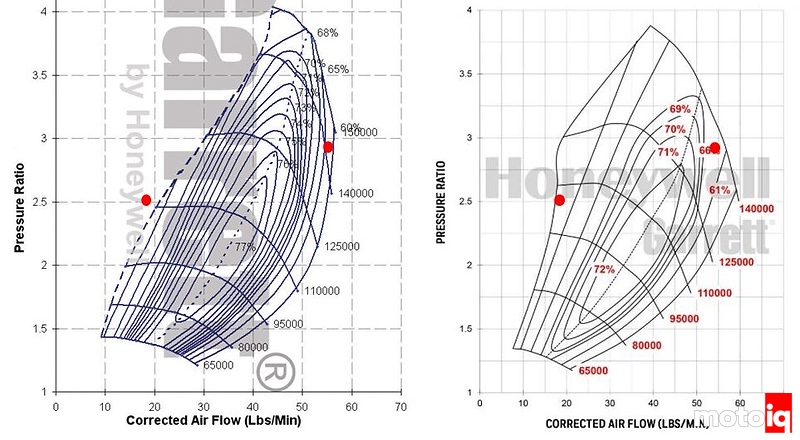
The compressor draws in and pressurizes air. Its flow capability largely determines the horsepower ceiling. Manufacturer compressor maps are useful because they show efficiency islands, surge limits, and the pressure ratios where the turbo works best.
You do not need to become a map-reading engineer before buying parts, but avoid choosing solely by a claimed horsepower number. Those ratings can vary by manufacturer and often represent crank horsepower under ideal conditions. A reputable turbo match should have enough flow for your target with a sensible margin, not a wildly inflated rating that leaves you with unnecessary lag.
Turbine Side: Response and Backpressure
The turbine housing and turbine wheel control how quickly the turbo responds and how much exhaust backpressure it creates. A tight housing generally spools faster, but it can choke high-RPM flow. A larger housing may support stronger top-end power, but response can suffer on a small engine.
A/R ratio is part of this equation. Lower A/R typically favors earlier spool, while higher A/R favors upper-RPM flow. There is no universal “best” A/R. Match it to displacement, gearing, RPM range, manifold design, and the kind of driving you actually do.
Build the Supporting System First
A turbo is only one piece of a boosted combination. Supporting parts are where reliable builds are made or lost. The best deal on a turbo means nothing if the fuel pump falls behind or the charge pipes blow apart on the first hard pull.
Fueling comes first. Larger injectors, a higher-capacity fuel pump, proper wiring, fuel lines, rails, and a suitable regulator may all be required. The exact parts depend on the engine and fuel choice. Pump gas has less knock resistance than ethanol blends, while E85 can make excellent power but demands considerably more fuel volume and compatible components.
Air temperature matters just as much. An appropriately sized intercooler lowers charge-air temperatures and gives the tuner more room to work safely. Do not buy the biggest core available just because it fills the bumper opening. Poorly routed piping, excessive pressure drop, or a core that blocks radiator airflow can create new problems.
Your exhaust side needs attention too. A free-flowing downpipe and correctly sized exhaust reduce restriction after the turbine. On externally gated setups, the wastegate must be correctly sized and placed to control boost without creep. A quality blow-off valve or bypass valve protects the compressor during throttle lift and helps keep the system responsive.
For most turbo upgrades, plan around these core areas:
- Fuel delivery sized for your power goal and fuel type
- Intercooling, charge piping, clamps, and couplers that hold pressure
- Exhaust manifold, downpipe, wastegate, and boost-control hardware
- Oil feed, oil drain, and coolant lines where the turbo requires them
- Gauges or data logging for boost, air-fuel ratio, fuel pressure, and temperature
Do Not Skip Oil Drainage and Heat Control
Turbochargers live in extreme heat and speed. Oil supply and oil drainage are not minor installation details. A restricted feed can damage bearings, but an oversized feed without the proper restrictor can also cause trouble on certain ball-bearing units. Follow the turbo manufacturer’s requirements rather than guessing.
The oil drain must flow downhill to the pan with no kinks, sharp bends, or sections that trap oil. If the drain backs up, oil can push past the seals and create smoke. On some low-mounted or rear-mounted turbo applications, a scavenge pump may be necessary to return oil reliably.
Heat management is worth the effort. Turbo blankets, heat shields, ceramic-coated components, and thoughtful routing can protect wiring, brake lines, hoses, and nearby electronics. They can also help reduce underhood temperature, but they are not a substitute for proper airflow and safe clearances.
Tuning Is Not Optional
A bolt-on turbo kit is not a bolt-on power number. The engine calibration must match the new airflow, injector data, fuel pressure, boost level, ignition timing, and safety limits. A conservative tune with clean data is faster in the long run than a max-effort tune that detonates the engine on a hot afternoon.
Use a tuner who understands your engine platform and fuel choice. Ask how they monitor knock, air-fuel ratio, intake air temperature, fuel pressure, boost, and injector duty cycle. On modern vehicles, transmission tuning may also be part of the package. Extra torque can expose weak shift scheduling, clutch pressure, or torque-management limits.
A wideband oxygen sensor and a dependable boost gauge are smart baseline tools. For more serious builds, data logging is the real advantage. Logs reveal pressure drops, boost spikes, lean conditions, excessive intake temperatures, and fuel-pressure loss before those issues turn into damaged pistons.
Know What the Drivetrain Can Take
Boost does not just increase horsepower. It adds torque, often much earlier in the RPM range than a naturally aspirated setup. That torque loads the clutch, converter, transmission, driveshaft, axles, differential, engine mounts, and tires.
Manual cars may need a stronger clutch before the turbo goes on. Automatic builds may need a better converter, valve body upgrades, extra cooling, or a transmission build depending on the platform. Wheel hop is another parts killer. If traction is inconsistent, suspension bushings, mounts, tires, and alignment deserve attention before you turn up the boost.
Engine internals are the other hard limit. Some stock engines handle moderate boost with excellent tuning. Others have weak rods, ring lands, head gaskets, or pistons that make aggressive boost a gamble. Research your exact engine generation, not just the badge on the valve cover.
Buy for Fitment, Then Verify Every Detail
Vehicle-specific shopping saves time, but fitment is more than year, make, and model. Confirm the engine code, drivetrain, trim, emissions equipment, transmission, and whether the kit is built for stock accessories or aftermarket components. A turbo manifold that fits one engine variant may interfere with another steering shaft, radiator fan, or air-conditioning line.
Before ordering, map the whole system: turbo, manifold, wastegate, downpipe, intercooler, piping, oil lines, fueling, sensors, tuning, and hardware. ProStreetOnline’s year/make/model fitment tools can help narrow the field, but always read the product details and measure your available space when the build is custom.
Do not let a low price push you into mismatched parts. Saving money on a turbo is great. Saving money by skipping fuel system upgrades, clamps, sensors, or tuning usually costs more later.
Make the First Pull a Smart One
Prime the turbo before startup if required, check every fluid connection, pressure-test the charge system, and inspect for exhaust leaks. Start with low boost and verify the tune, fuel pressure, temperatures, and boost control before chasing a bigger number. The cleanest builds make power because every part has a job, every connection is checked, and the driver knows when to stop and fix a problem.
Build for the way you drive, buy parts that work as one system, and let the boost come after the foundation is ready.